
Choking On AI's Toxic E-Waste Legacy
- By Winston Thomas
- September 16, 2024
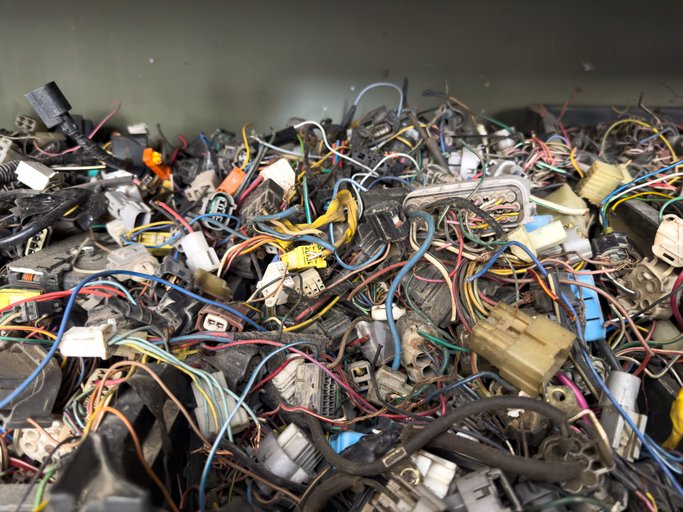
The AI fanfare is hiding a toxic secret: the mountains of discarded electronics grow ever higher. It's that part of the AI revolution that no one likes to discuss. But as we chase faster, more powerful AI, discarded electronics pile up, leaving a toxic legacy that might overshadow AI’s well-intentioned benefits.
Mark Jobbins, vice president and chief technology officer for Asia Pacific and Japan at Pure Storage, highlights the concern: “We're seeing huge uptakes in the technology needs for AI,” he warns. “One of the concerns is that the technology you deploy to run that AI software solely needs upgrades on a more regular basis, and you just end up with this... legacy technology that's not able to keep pace, or you end up having to continually refresh it, creating more e-waste.”
It's a chilling revelation that often gets lost between the claims of AI’s benefits. The relentless pursuit of faster, more powerful AI hardware is driving a cycle of obsolescence that's leaving a trail of discarded servers, storage devices, and other electronics in its wake.
Hacking the conventional wisdom
E-waste is not just an AI problem; it’s been a dirty secret of IT innovation for a long time. Only auditors and regulators monitor it closely, with information often nestled inside the pages of an annual report.
Although there have been major advances in recycling and upcycling waste, it’s nowhere near the amount of e-waste produced daily, which was 59.4 million metric tons in 2022, according to the E-Waste Monitor. GenAI just hit the masses around this period, and AI has not been factored in yet.
Poor recycling rates are not helping. For example, China, the top e-waste producer in 2024, according to the article, only recycles 16% of it. The U.S., which is not any better by coming in second, recycles 15% of the waste. There are major outliers like India, which produces the third most amount of e-waste but recycles only 1%, while fifth-place Brazil recycles virtually nothing.
The definition of e-waste is also narrow, often focused on the electronic component. Many usually overlook other types of waste related to obsolescence. The truth is much more nuanced. “It's not just about the end-of-life of these devices,” Jobbins emphasizes. “It's also about the energy consumption and carbon emissions associated with their production and operation.”
The AI impact on e-waste
AI adds two more dimensions to this perennial e-waste headache, making it an unwelcome accelerant. One is that it forces companies to upgrade their hardware rapidly. While many data centers are looking to upgrade to support AI, the sudden spike in technology obsolescence and refreshes is turning these facilities, once hailed as the cathedrals of the data-driven age, into graveyards of outdated tech.
A related issue is that AI hardware design is constantly evolving. Companies are investing in new designs that allow for better AI processing, from more energy-savvy chipsets to new cooling techniques that will need new types of hardware.
As Jobbins explains, "AI will potentially accelerate development cycles. So potentially, you'll get more products coming through that will be updated."
All these issues mean that the rate of refreshes and obsolesce will increase as companies try to balance operational savings, carbon footprint, obsolescence, FOMO and innovation.
But there’s a twist in this tale: AI, the technology accelerating the e-waste problem, can also be part of the solution to decelerate it. "AI may accelerate the innovation of new technologies that can ultimately be more eco-friendly," Jobbins suggests.
For example, AI-powered recycling robots can efficiently disassemble e-waste, better recover valuable materials, and minimize environmental impact.
Jobbins also cites the use of AI to determine tech refresh cycles and improve hardware maintenance as just a start to a future where AI will be integral to e-waste management. Picture machine learning algorithms predict failure patterns, extend components' lifespan, and reduce waste.
AI can also improve the durability of components used in other industries. For example, AI can optimize the design and manufacturing of healthcare devices, making them repairable and recyclable.
This isn't science fiction. It's a vision that's within reach, says Jobbins. But reality requires a paradigm shift. He adds that we need to move beyond the linear “take, make, dispose” model and embrace a circular economy where resources are kept in use for as long as possible.
It’s also where the most significant problem lies.
Stepping up to the challenge
Companies like Pure Storage are already addressing the problem from their perspective. For example, the company's Evergreen architecture, which allows for non-disruptive upgrades, is a testament to its commitment to sustainability.
Pure Storage also designed its flash modules so as not to be blindsided by reliability issues that were outside its control. Besides improving data storage reliability and reducing costs, this allowed the company’s engineers to reduce the number of components (hence potential e-waste) and make them last longer.
As Jobbins puts it, “The technology that's been removed, we actually reuse a number of those components... so we can actually extend the life of that technology and reduce that e-waste component.”
Pure Storage’s quest to better balance the sustainability equation continues. Its recent investment in ceramic-based data storage player Cerabyte is already turning heads.
More importantly, companies are starting to advocate sustainability by publishing ESG reports. Pure Storage’s ESG Report 2024 is one example.
But the responsibility doesn't lie solely with tech players and manufacturers. Consumers, governments, and all industries must play a role in creating a sustainable AI ecosystem. It's time to demand more durable, repairable products, support responsible recycling initiatives, and hold companies accountable for their environmental impact.
Tick, tok, tick, tok…
The e-waste crisis is a ticking time bomb. As AI continues its exponential growth, the volume of discarded electronics will only increase. We can't afford to wait for regulations or consumer pressure to force change. The time to act is now.
“If you're not thinking about it now, you're going to end up painted in a corner,” Jobbins warns. While he acknowledges that the future of AI is bright, he firmly believes it must be green.
By harnessing the power of AI for good, we can create a world where technological advancement and environmental stewardship go hand in hand. The choice is ours: will we seize this opportunity or allow our lust for smart machines to consume the planet to take us over?
Image credit: iStockphoto/Bilal photos







Winston Thomas
Winston Thomas is the editor-in-chief of CDOTrends. He likes to piece together the weird and wondering tech puzzle for readers and identify groundbreaking business models led by tech while waiting for the singularity.