
How AI is Enhancing Efficiency in Healthcare
- By Paul Mah
- March 12, 2025
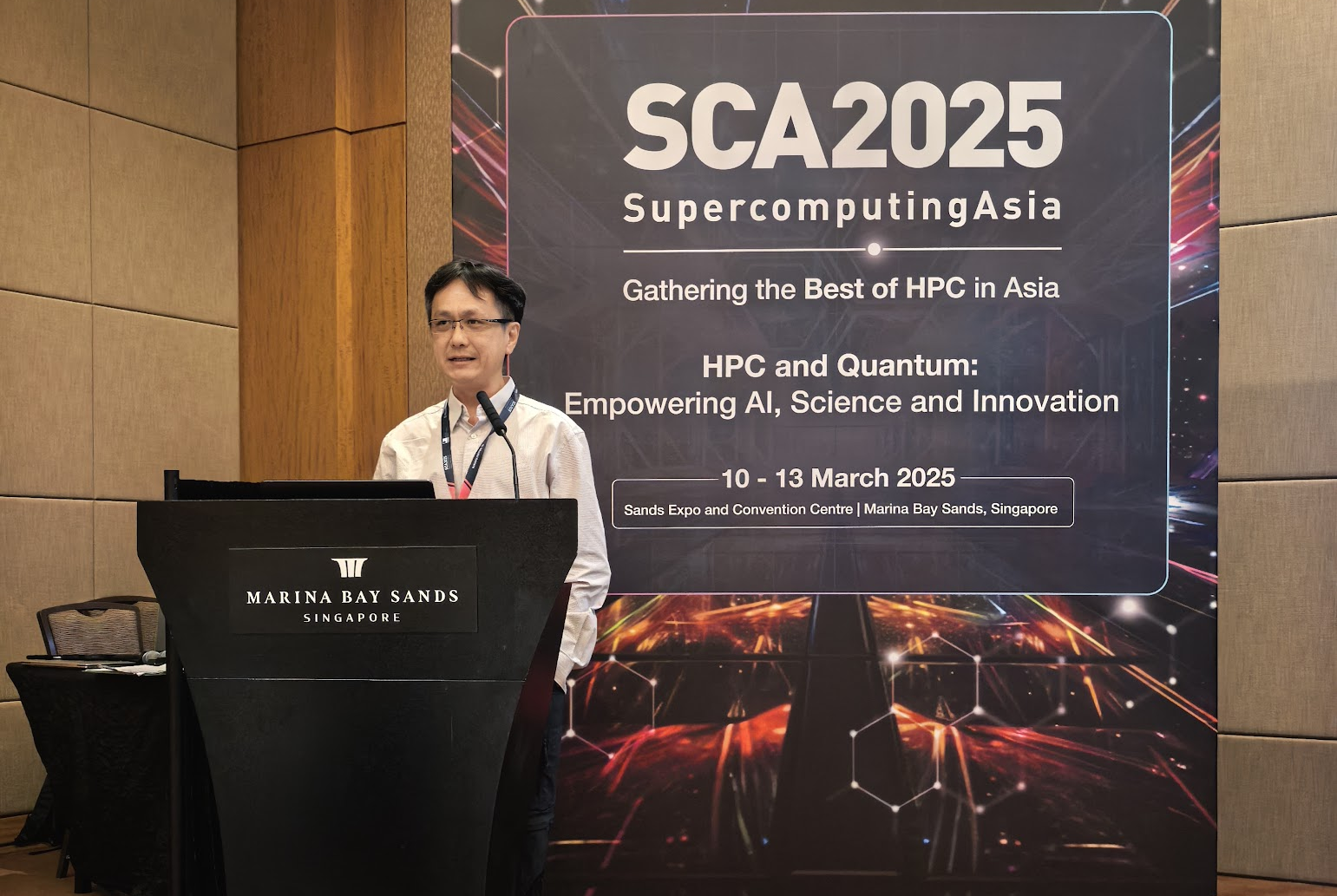 Despite ongoing efforts by enterprises to adopt AI, few have fully integrated it into operations or achieved significant ROI. However, Dr. Robby Tan, chief scientist at Asus Intelligent Cloud Services, has successfully deployed a commercial AI solution in healthcare.
Speaking at SuperComputingAsia 2025 in Singapore this week, Dr. Tan highlighted key capabilities of Asus Miraico, described as the world's first AI-powered medical coding system for healthcare cost management. He shared about how his team implemented various AI-based features designed to assist doctors, as well as overcome AI hallucination.
"Administrative tasks are a significant burden for healthcare, especially in hospitals. Doctors, nurses, and other healthcare staff face numerous administrative requirements. If we can reduce these administrative tasks for healthcare providers, they can focus more on patient care," he said.
AI in healthcare
Miraico's key feature is its real-time automatic recommendation of ICD codes, which are essential identifiers for specific illnesses used in billing and insurance claims. The challenge is substantial: the latest version, ICD-11, contains approximately 120,000 different illness codes.
According to Dr. Tan, the team used a dual approach involving predictive and generative technologies to to address this. Patient notes written in various languages are processed through a BERT model to get the feature representation of these notes, upon which classification is performed. This system is currently live for ICD recommendation, says Dr. Tan.
The generative model offers broader applications beyond ICD codes, including drug recommendations. "We retrained an LLM and further fine-tuned it using recommendation classes as ground truth, employing continuous pre-training and fine-tuning," Dr. Tan noted. "This generative approach is more versatile and applicable to diverse consumer uses."
"Our innovation is basically on the agent-centric LLM or patient-centric foundation model. The goal is to have an LLM like GPT, Gemini, or Claude with strong knowledge and understanding of our patient data."
Managing hallucination
Hallucination, or confabulation, is an inherent challenge in LLMs that persists even in cutting-edge systems. Some experts believe these issues can never be fully eliminated. As Dr. Tan observed: "Hallucination is difficult to address because it's an intrinsic characteristic of LLMs. Most of us who have used ChatGPT have witnessed its occasional hallucinations - this is a fundamental trait we must suppress in our work."
To combat this issue, Dr. Tan's team developed a novel approach. Their process begins by extracting key information from transcripts to generate an initial summary, which then undergoes hallucination detection. A specialized hallucination suppression agent employing Natural Language Inference (NLI) breaks sentences into atomic facts and validates each against the source data, eliminating any fabricated statements. The refined summary is then sent for human verification by a physician before final approval.
Dr. Tan explained: "After removing hallucinated content from the summary, we also verify that it retains the most crucial information from the original data. That's why our key information extraction agent performs verification before the summary reaches a doctor for final review."
Tackling noise
Noise is another problem in a hospital environment, which the built-in dialog transcription agent must address. As the name suggests, the agent listens to conversations between doctors, patients, and nurses, automatically transcribing captured speech into text.
"The environment in the hospital can be very noisy. LLMs or GPT are not trained to deal with medical terms. For example, if someone says 'I took Tylenol' in a noisy environment, the LLM might interpret it as 'I took a tile,' which is very different from the term 'Tylenol,'" said Dr. Tan.
To address this issue, the team developed a robust system through adversarial training. "We deliberately augment the text to be wrong, then train the LLM to get used to this wrong augmentation. Once the LLM gets used to this wrong augmentation, we can have a more robust ASR (automatic speech recognition) system."
"We are working on AI that can enhance healthcare, focusing on administrative AI agents that can streamline workflow by automating tasks... our core model is powered by Asus and Nvidia servers, and we are actively recruiting AI engineers," he concluded.
Image credit: Paul Mah









Paul Mah
Paul Mah is the editor of DSAITrends, where he report on the latest developments in data science and AI. A former system administrator, programmer, and IT lecturer, he enjoys writing both code and prose.