
The AI Agent Revolution That Isn’t Happening Yet
- By Winston Thomas
- December 10, 2025

The buzzword in enterprise tech is “agentic AI”, those promised digital assistants that work independently, make decisions without human oversight, and theoretically transform how businesses operate. According to vendors, they’re the next evolutionary leap beyond those clunky chatbots we’ve been beta testing for the past year.
There’s just one problem: Almost nobody is actually deploying them.
A Gartner survey of 360 IT application leaders reveals that only 15% are currently considering, piloting, or deploying fully autonomous AI agents. That's a surprisingly small-scale response to technology that’s been hyped as transformational. While 75% of respondents said they’re working with some form of AI agents, the gap between “some form” and “fully autonomous” is doing a lot of heavy lifting here.
"The hype around agentic AI continues to grow, with vendors positioning AI agents as the next phase of AI evolution that will address the shortfalls of more traditional GenAI assistants," says Max Goss, senior director analyst at Gartner. That means the sales pitch is ahead of the product.
The hesitation is rational. IT leaders cite governance concerns, security vulnerabilities, and the ever-present specter of AI hallucinations. Only 19% have high or complete trust in vendors to provide adequate hallucination protection, which means 81% are watching their AI tools like nervous parents at a swimming pool. Meanwhile, 74% believe AI agents create new attack vectors, and only 13% strongly agree that they have proper governance structures in place.
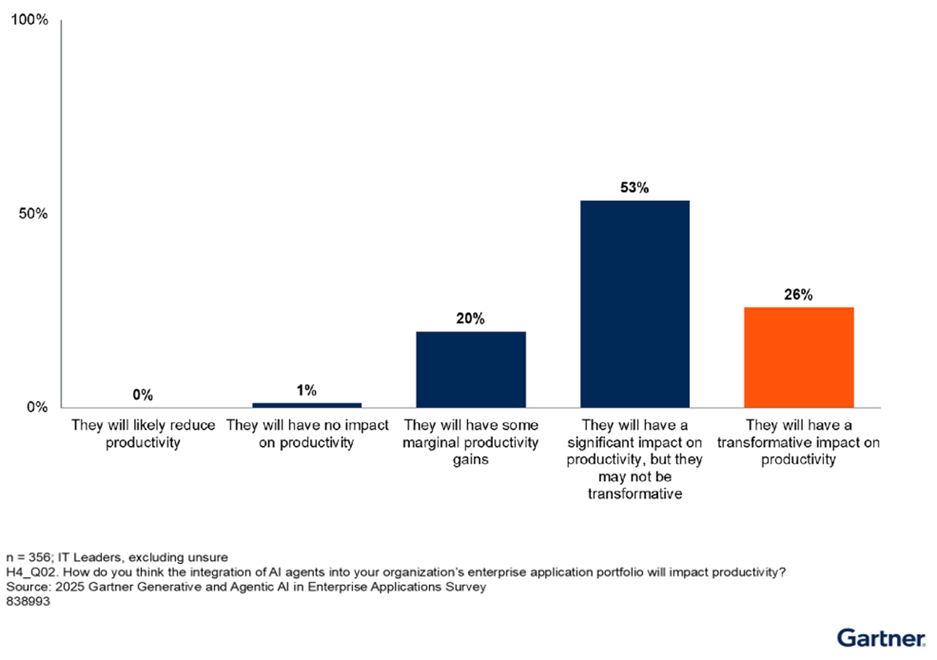 When asked about impact, the survey response was underwhelming. Just 26% expect AI agents to be transformative for productivity. Most (53%) predict “significant but not transformative” results, while 20% foresee only marginal gains. It’s the kind of measured enthusiasm you’d expect from people whose jobs depend on not overselling the next big thing.
The data suggests many organizations are flailing. Only 14% strongly agreed that there is alignment among IT, business users, and leadership on which problems AI should actually solve. Without that alignment, companies default to the path of least resistance: office productivity tools. Organizations lacking a clear AI strategy are twice as likely to focus agents on digital workplace applications rather than on high-value domains such as customer service, ERP, or sales.
“Office productivity and the digital workplace are the default for those organisations that don’t have a strong grasp on what they are doing with agents, but they are not necessarily the areas that will provide organisations with the most value,” Goss notes. Among all respondents, analytics and business intelligence ranked highest (64%), followed by customer service (55%) and office productivity (39%).
As for the existential questions: will AI agents replace applications? Will it replace workers? Most leaders aren't losing sleep yet. Only 12% strongly agreed agents would replace applications within two to four years, and just 7% believed they’d replace workers in that timeframe.
Gartner’s advice? Develop platform-agnostic governance, target high-impact domains, and maintain a multivendor strategy. In other words: proceed carefully, avoid vendor lock-in, and remember that transformative technology doesn’t need a hard sell as it sells itself.
Image credit: iStockphoto/Mininyx Doodle; Chart: Gartner








Winston Thomas
Winston Thomas is the editor-in-chief of CDOTrends. He likes to piece together the weird and wondering tech puzzle for readers and identify groundbreaking business models led by tech while waiting for the singularity.