
The Company Is the Variable
- By Winston Thomas
- June 08, 2026
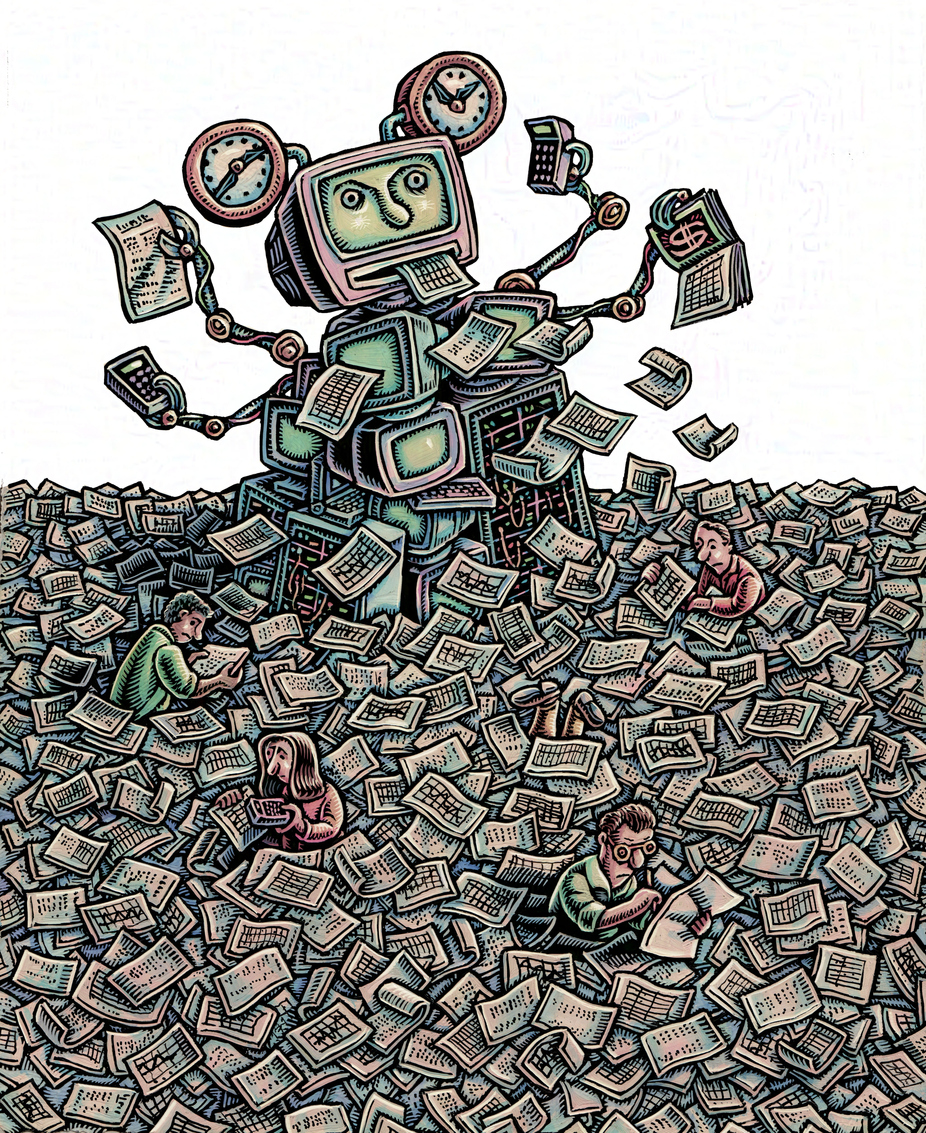
The week after a merger closes is usually when the trouble surfaces. Two finance teams that spent years booking the same transaction two slightly different ways are now feeding one shiny new AI system. The model does exactly what it was built to do. It reconciles, categorizes, and recommends confidently and at speed. Then, it propagates the discrepancy faster than any human could. Nobody wrote a bad algorithm. They wired a fast brain into a slow argument no one had bothered to settle.
That scene, in some variation, is what Jennifer Colapietro keeps walking into. As PwC’s digital core modernization leader, she works the seam where AI meets the systems that run a business: the ledger, the org chart, the controls. Her explanation for why so many AI programs stall has almost nothing to do with technology. “AI amplifies the strengths and weaknesses of the digital core,” she says. “If processes, data, and governance aren’t standardized, the AI scales inconsistency instead of efficiency.”
The independent numbers make her point for her. MIT’s 2025 State of AI in Business report found that roughly 95% of enterprise genAI pilots delivered no measurable value. PwC’s own 29th Global CEO Survey put 56% of chief executives in the group that has seen no significant financial benefit from AI to date. PwC, it should be said, sells the cure for exactly this, so take the prescription with a pinch of salt. The diagnosis is harder to argue with: the spend is enormous, and the returns are mostly missing.
The more useful question for a chief data officer, then, isn't whether the AI works. It is whether the company is built to let it.
Enterprise AI doesn’t fail — it exposes
Enterprise AI rarely fails because the model is wrong. It fails because the model is right, and the organization wasn’t ready for what that accuracy would reveal.
Point a capable model at finance or HR, and it behaves less like a tool than an auditor with no manners. “Very quickly, AI becomes a diagnostic tool,” Colapietro says. “It reveals where processes break down, where ownership is unclear, and where organizations have been relying on manual workarounds instead of standardized ways of working.” The duplicated workflows in a slide deck could persist for years, but they do not survive contact with a system that requires a single, consistent definition of “revenue” to function. What looks like a model-quality problem turns out to be the company, testifying against itself.
95% of enterprise generative-AI pilots deliver no measurable value — MIT, 2025. 56% of CEOs report no significant financial benefit from AI — PwC, 2026. The model is rarely the problem.
A second pattern shows up just as fast, and it is an absence rather than a flaw. Organizations accumulate pilots the way junk drawers accumulate cables: dozens of them, disconnected, each owned by a different function, and none of it adding up. What’s missing is a person. Colapietro calls that person the enterprise “quarterback,” someone “empowered to align the digital core, operating model, and business priorities.” Without one, a company can experiment indefinitely, mistaking motion for momentum.
Why you can’t just bolt it on
The tempting move is to treat AI as a layer, a clever skin stretched over whatever systems you already run. Colapietro argues that this is the dangerous part. Laid over fragmented data and ungoverned processes, a model does more than speed things up. “AI does not just automate work,” she says. “It can amplify operational inconsistency, governance gaps, and decision-making risk at scale.”
Her fix is structural: standardize the processes, align the data, settle the decision rights, and stop treating ERP as a filing cabinet. “Modern ERP platforms have evolved into the operational backbone of the enterprise,” she says, “providing the structure, consistency, and governance that allow AI to scale in a way that is trusted, auditable, and effective.”
Trust has no feeling. “In an enterprise environment, trust in AI is not abstract,” she says. “It is operational.” It looks like role-based access, approval thresholds, segregation of duties, a real audit trail, and an explicit route for escalating the moment a model does something inexplicable. The line between a credible system and an impressive demo is whether a human can later explain, challenge, and defend whatever the machine decided.
What the board deck rarely captures is that none of this is really about machines. AI redistributes authority, and authority is personal. “AI is not just a technology shift,” Colapietro says. “It is a redistribution of decision-making inside the enterprise.” When a model starts approving what a middle manager used to approve, the resistance seldom arrives as an argument. It arrives as drift: the pilot that never quite gets adopted, the exception that always seems to need a human after all.
Which leads to the sentence hardest to say out loud in a boardroom: that the thing in the way is the organization, not the technology. “The primary barrier to scaling AI is usually not the technology,” Colapietro says. “It is the organization itself.” Boards reach for budgets and tools because those are buyable. The real work, often involving standardizing operations, fixing accountability, and redrawing who decides what, is slower and more political, and it predates the AI by years.
The companies that make it across do the unglamorous things in the first ninety days. They start from a business outcome and reason backward to the AI. They name an accountable owner before they name a use case. They repair the operating model before they ask it to carry anything at scale.
The takeaway for a CDO is uncomfortably simple. The model is probably ready; the company is the variable.
Image credit: iStockphoto/Lisa Haney









Winston Thomas
Winston Thomas is the editor-in-chief of CDOTrends. He likes to piece together the weird and wondering tech puzzle for readers and identify groundbreaking business models led by tech while waiting for the singularity.