
When Production AI Fails Silently: An Engineering Playbook for Building Reliable AI Systems
- By Prince Okon
- October 01, 2026

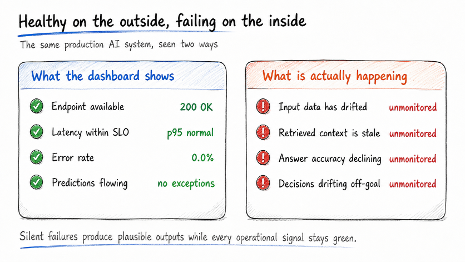
Picture a production AI system that looks healthy by every conventional measure. The endpoint is available. Latency sits comfortably within its service-level objective. No exceptions appear in the logs, and predictions keep flowing. Yet its answers have gradually become less accurate because the data, context or user behavior it was built on has shifted.
That is the difference between visible failures — crashes, timeouts and explicit errors — and silent ones: plausible outputs that are stale, incorrect, biased or no longer aligned with the business objective. For chief data officers and their engineering teams, silent failure is the more dangerous category, because nothing in the standard operations stack is designed to catch it.
Why conventional monitoring misses AI failures
Traditional monitoring asks operational questions: Is the service available? Is latency within its limit? Are error rates normal? Production AI adds behavioral questions that infrastructure tooling cannot answer: Are predictions still accurate and useful? Is the system retrieving the right information? Have operating assumptions changed? Can the team reconstruct why an important decision was made?
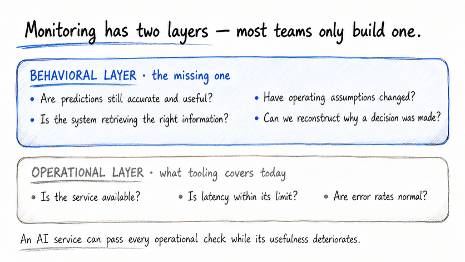
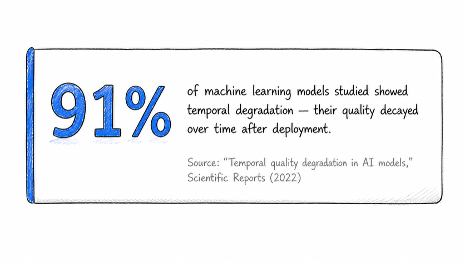
An AI service can return HTTP 200 responses all day while its usefulness deteriorates. This is not an edge case. A study published in Scientific Reports found temporal degradation in 91% of the machine learning models examined. Infrastructure health is necessary but insufficient. Evaluation, observability, guardrails and governance form the missing layer between a working feature and a production-ready system.
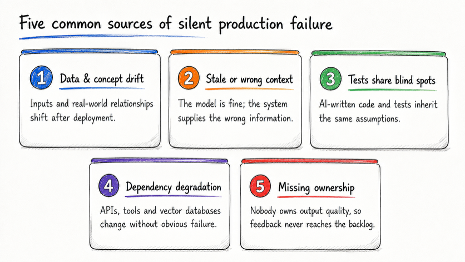
Five common sources of silent failure
Data and concept drift. Input distributions, customer behavior or real-world relationships change after deployment, and the system keeps operating against assumptions that are no longer valid.
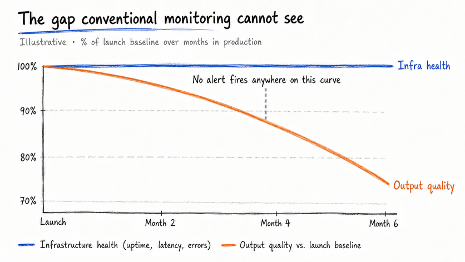
Stale or incorrect context. For LLM and retrieval-based systems, the model may function correctly while receiving irrelevant, incomplete or outdated information. The diagnostic shift matters: Sometimes the model did not answer badly; the system supplied the wrong context.
Tests that share the implementation's blind spots. Test suites tend to validate expected cases rather than unknown operating conditions. When AI assists with both code and test generation, the implementation and its tests can inherit the same assumptions — and bugs involving boundary conditions, time zones and rare states pass every check until production finds them.

Dependency and tool-chain degradation. AI systems lean on APIs, retrieval services, vector databases and external tools, any of which can change its schema, permissions, latency or response quality without producing an obvious failure.
Missing ownership and feedback loops. Silent failures persist when nobody owns output quality after deployment. If user feedback, incidents and evaluation results never return to the engineering backlog, the system repeats the same mistakes.
A practical reliability framework
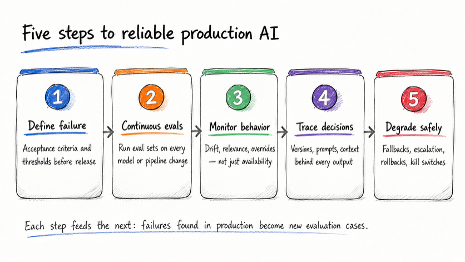
Define failure before deployment. Create explicit acceptance criteria for output quality, safety, relevance, fairness, cost and latency, and establish baselines and failure thresholds before release.
Build continuous evaluation into delivery. Maintain representative evaluation datasets and run them whenever the model, prompt, retrieval pipeline, tool set or data source changes. Include edge cases drawn from real production incidents. Evaluation and monitoring belong to a continuous lifecycle, not a one-time launch checklist.
Monitor behavior, not just availability. Track drift in inputs and features, retrieval relevance, low-confidence responses, task-completion rates, tool-call failures, human override rates, and performance across important user groups. Pair automated alerts with periodic human review of real production outputs.
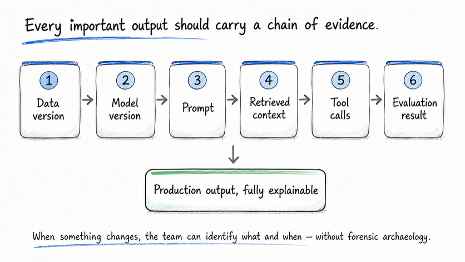
Make every decision traceable. Record the data version, model version, prompt, retrieved context, tool calls and evaluation result behind important outputs. Treat the pipeline as a chain of evidence so teams can identify what changed, and when, without reconstructing incidents from scattered logs and institutional memory.
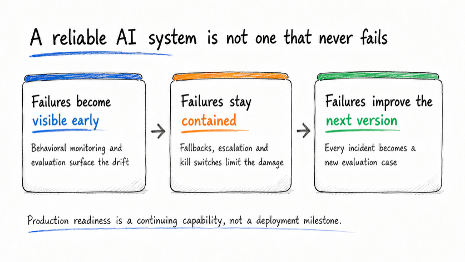
Design for safe degradation and recovery. Provide confidence thresholds, human escalation paths, deterministic fallbacks, rollbacks and kill switches for high-risk workflows. Reliability means reducing both the probability and the consequences of failure.
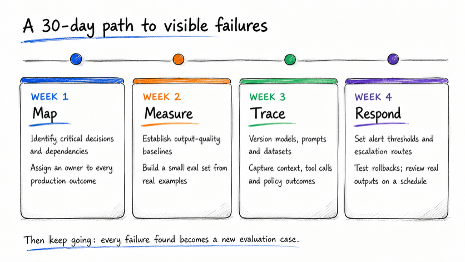
Teams can stand this up in about 30 days: Map critical decisions, dependencies and owners in week one. Establish quality baselines and a small evaluation set in week two. Version models, prompts and datasets, and capture context and tool calls, in week three. Define alert thresholds, test rollbacks and schedule recurring output reviews in week four — then convert every failure found into a new evaluation case.
Why this matters now
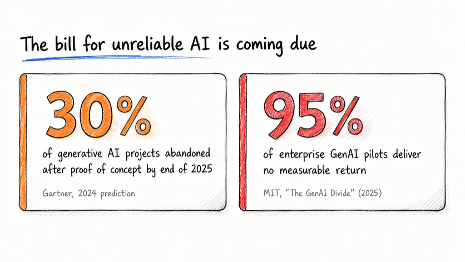
The bill for unreliable AI is coming due. Gartner predicted that 30% of generative AI projects would be abandoned after proof of concept by the end of 2025, citing poor data quality and inadequate risk controls. MIT researchers found that 95% of enterprise generative AI pilots deliver no measurable return. The organizations on the wrong side of that divide are not the ones with worse models; they are the ones that cannot see, explain or correct what their systems do in production.
CDOs and data engineers who ignore silent failure will discover it the expensive way — through customer harm, regulatory exposure and executives who quietly stop trusting the numbers. Every month a degraded system runs undetected, bad outputs compound into bad decisions. Those who act now turn reliability into a competitive advantage: A trustworthy AI system is not one that never fails, but one whose failures become visible early, stay contained and make the next version better.
The views and opinions expressed in this article are those of the author and do not necessarily reflect those of CDOTrends. Image credit: iStockphoto/Techa Tungateja; Figures from contributor









Prince Okon
Prince Okon is a senior data scientist and he leads the development and deployment of production AI, NLP and machine learning systems. He has more than eight years of experience in AI/ML engineering and data science, and serves as a Technical writer for Omdena.