
Your Cloud Operations Aren’t Ready for AI
- By Carlos Casanova, Charlie Dai and Courtney Nash, Forrester
- November 23, 2026
Is your system working?
That’s the question that teams have been trained to answer for decades. In today’s AI-enabled ecosystems, that question is insufficient. An AI service can be available, responsive, and technically healthy while still producing wrong answers and drifting away from expected behavior. Worse, it can violate policy and burn through your budget without your awareness. You know the system is up and running, but you may not know that it’s failing you. The definition of “healthy” has changed, and cloud operations must change with it.
Stop treating AI as another cloud workload
Structurally, AI workloads are different. GPU-centric compute introduces new capacity and scheduling constraints while AI workloads can create much more variable demand. Data movement and model behavior become financial operating concerns, not just data management issues, because your costs are now tied to how models and workloads behave.
Most concerning is how AI systems fail. Failures may surface as gradual degradation rather than a clear outage. That makes problems easier to miss or dismiss as low priority until the impact is significant. All this fundamentally changes what operations teams must observe, what they must optimize, and what they consider a failure.
Observability is your connective tissue, not just your monitoring layer
The first step is recognizing that AI-enhanced observability is not the same as observability for AI. AI-enhanced observability uses AI itself to improve operations through capabilities such as anomaly detection, correlation, summarization, and eventually remediation.
Observability for AI, however, is different. Here, the AI itself is what is being observed. We’re observing things such as model drift, output quality, prompts, agent behavior, token consumption and cost, and business outcomes. The industry tends to blur these concepts together when it should instead recognize the expanding chain of operational visibility: infrastructure to application to model to agent to business outcome.
Resilience must account for AI behavior
Earlier, we asked whether your system was running. Resilience requires another question: Can you restore the service to a trustworthy state? Traditionally, restoring the application or infrastructure was the measure of recovery. That’s no longer sufficient. Recovery must include model resynchronization, pipeline restarts, cache restoration, controlled rollback, and other AI dependencies.
More importantly, what do you recover when nothing technically failed? An AI service can remain operational while producing unreliable or unsafe outputs. Restarting the application or infrastructure may not fix the problem. AI resilience now means restoring trustworthy behavior. You can’t just focus on restoring uptime.
What it means: Operations must move from system health to outcome health
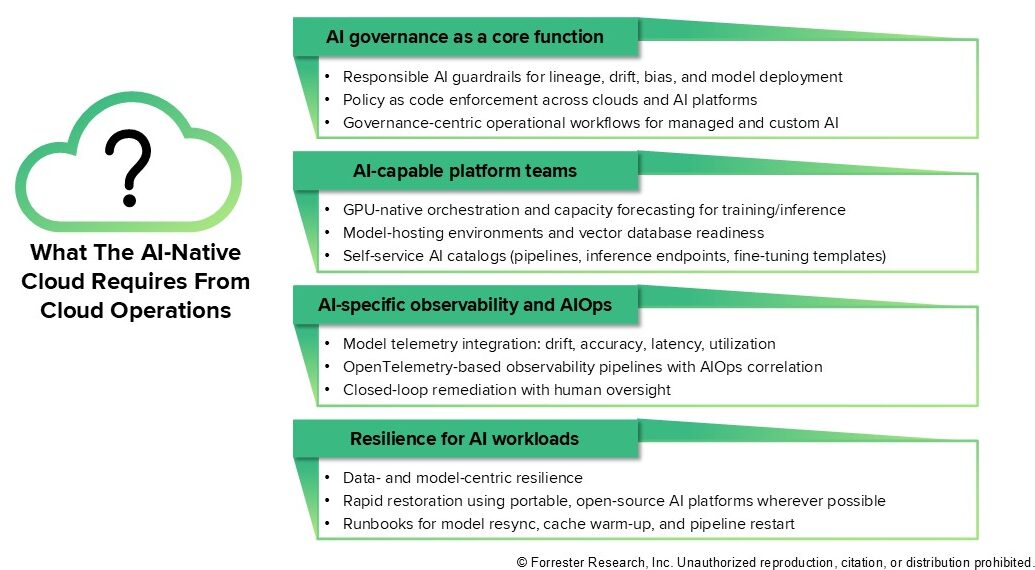
AI-native operations must move from system health to outcome health. That requires visibility into whether AI services remain trustworthy, economically sustainable, and aligned with intended business outcomes. Enterprises must retool operations for the AI-native cloud and modernize cloud operations for AI workloads while improving visibility, controlling costs, and strengthening resilience.
The original article is here.
The views and opinions expressed in this article are those of the author and do not necessarily reflect those of CDOTrends. Image credits: figure from Forrester; iStockphoto/Daryna Terokhina
Stay ahead with CDO Nexus
Join an exclusive community of CDOs and data leaders
- Access curated trends and thought leadership from IBM and industry experts.
- Participate in private roundtables and webinars to solve regional CDO challenges.
- Connect with a network of like-minded leaders navigating the same data landscape.









Carlos Casanova, Charlie Dai and Courtney Nash, Forrester
Carlos Casanova is Forrester’s principal analyst. Carlos serves technology architecture and delivery (TAD) professionals. His research includes artificial intelligence for IT operations (AIOps), Observability, digital experience monitoring (DEM), application performance monitoring (APM), infrastructure monitoring, cloud monitoring and the use of OpenTelemetry in these areas. Additionally, and as related to his areas of research, he'll also dive into automation, infrastructure management, and configuration management databases (CMDBs). Carlos' decades of experience as a practitioner in a wide array of operational and risk management disciplines gives him a unique ability to provide broad, perspective-based guidance.
Charlie Dai is Forrester’s vice president and principal analyst. Charlie serves technology executives and offers strategic advice and guidance to Forrester clients in broad areas including cloud (cloud-native technologies, public cloud, and hybrid cloud management), big data and AI (ML, computer vision, and data management), IoT (IoT device OS and IoT software platforms), blockchain, commercial drones, quantum computing, DevOps, digital process automation, low-code, and open-source software. Charlie has rich experience in technology strategy, enterprise architecture, and software delivery management, leading global research on technology architecture in several emerging technology areas. He also focuses on vendor landscape and best practices in China, Asia Pacific, and worldwide.
Courtney Nash is Forrester’s principal analyst.