Your Best Metadata Just Took a Severance Package
- By CDOTrends editors
- September 13, 2026

Gartner published a forecast on Sept. 10, 2026 that reads like a punchline at a comedy talk show. By 2029, companies will need to rehire the 30% of employees laid off because AI replaced their work. And they will do at a significantly higher cost.
Run that through a budget and severance goes out. License fees go to the vendor that justified the cut and a recruiter’s fee lands 18 months later. Then a salary premium buys back knowledge the company previously owned.
The numbers in this story come from Gartner’s Hype Cycle for the Future of Work, 2026 (paywall). And here’s another one: by 2027, companies that book AI gains as cost savings get overtaken by companies that reinvest them. Tori Paulman, the Gartner vice president analyst behind the research, calls the early AI era a category error. Executives believed automation was the point, Paulman said, when “workforce amplification was the opportunity.”
Most outlets will file this under HR. In reality, it belongs to the data office.
Why AI layoff reversal by 2029?
Gartner’s stated that workforce cuts drain talent pipelines and erode institutional knowledge.
Institutional knowledge is a polite name for the metadata nobody wrote down. This can include anything, from why that table is joined that way to which customer segment was renamed in the CRM in 2019 and never in the warehouse, and which of the four churn numbers the board has been reading since 2023.
None of it sits in your catalog. Instead, it sits in one person’s head, and the reporting ran on it. An agent cannot work that out. So, it will pick a definition and answer with full confidence, making it worse than answering wrong slowly.
The second number is costlier
By 2027, Gartner expects 75% of organizations that treat AI productivity gains as cost savings to be overtaken by competitors that put the same gains back into innovation, modernization and upskilling.
Savings are easy to measure and easy to defend in a quarterly review. Reinvestment is harder is a harder sell. It means arguing that the twelfth AI use case should cost less than the first, because the eleven before it left something behind: a governed pipeline, an agreed definition, and a test harness the next team can reuse.
Gartner calls that compound value. Data teams already have a word for the opposite: Rework.
Where the cycle sits now
The 2026 Hype Cycle places early AI investment in the trough of disillusionment, the stage after the excitement fades and before the technology settles into normal use. Budgets now get defended with numbers. A data leader can finally ask what a use case ties back to without sounding obstructive.
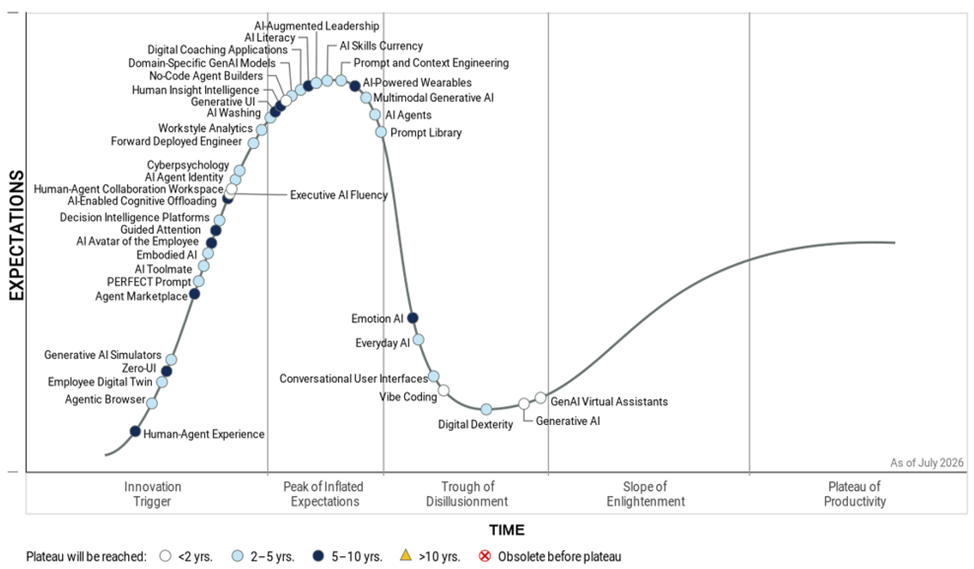
Gartner lists four shifts:
- Build AI that strengthens human judgment while a person stays accountable.
- Grow employees who adapt rather than simply adopt.
- Protect context and human oversight inside automated processes.
- Make each use case safer and cheaper than the one before it.
The third and fourth land on the data office.
Run an exit interview for your data
Before the next role gets automated, book an hour with the person doing it. It’s not about the job but about the data they touch. Look for:
- Definitions they own. The fields and metrics where they are the final word, and who else depends on them.
- Exceptions they apply. Records they exclude, periods they adjust, rules that exist nowhere in code.
- Fixes they make quietly. Reports they correct before sending, and what breaks when nobody does.
Write it down and store it where an agent can read it.
Paulman’s alternative to deep cuts is a “talent remix”: move people off low-value work instead of off the payroll. The data version costs less. One hour now, against a signing bonus in 2029 and a definition nobody left in the building can explain.
Image credit: iStockphoto/Gazometr
Stay ahead with CDO Nexus
Join an exclusive community of CDOs and data leaders
- Access curated trends and thought leadership from IBM and industry experts.
- Participate in private roundtables and webinars to solve regional CDO challenges.
- Connect with a network of like-minded leaders navigating the same data landscape.